Marseille, January 2029
[ ELIAS NOUREPSIL ] Former Drone Technician — Marseille
─────────────
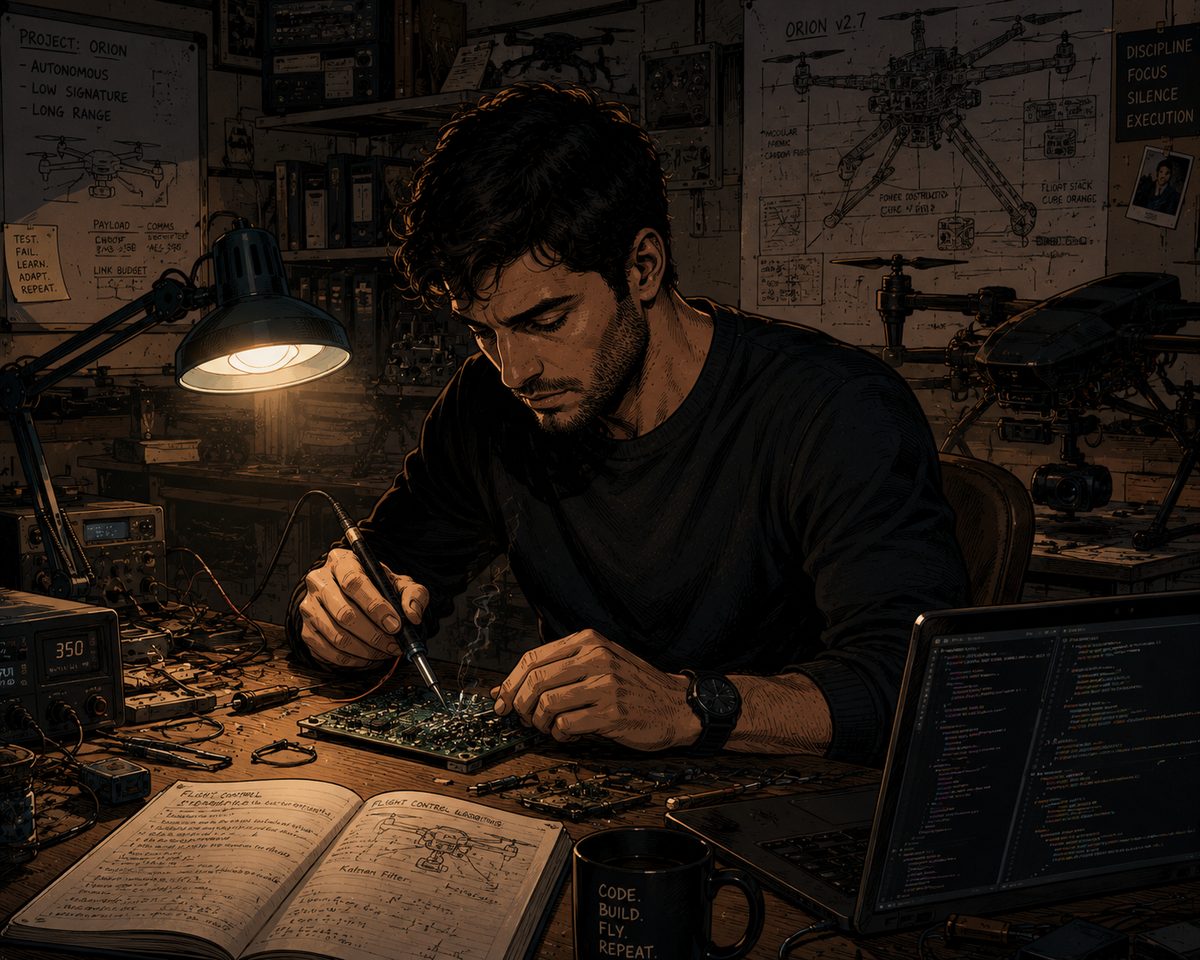
He had a gift for machines.
Not the theoretical gift — not the kind that expressed itself in engineering degrees and research papers and clean diagrams on whiteboards. A tactile gift, the kind that lived in his hands and fingers, in the instinct that told him before he opened a casing that the problem was the third capacitor from the left, in the ability to hold a component and feel the wrongness in it before any diagnostic confirmed the failure.
He had grown up repairing things in his father's shop in the 11th arrondissement — appliances, electronics, anything that came through the door. By sixteen he had rebuilt three motorcycles from salvaged parts. By twenty-two he had moved into drones, initially as a hobby, then as a profession, working for survey companies and film crews and agricultural services. He was meticulous and fast and reliable, and in a field where systems failed at inconvenient moments and clients panicked, those qualities made him valuable.
By 2027, he was doing something else.
The food riots had started in February — not in Marseille initially, but visible from there, spreading up through the news in a pattern he watched with the growing recognition that the pattern was not slowing. The southern suburbs had been hit hard: unemployment concentrated in communities that had been managing precarity before the crisis and now had nothing managing it. Supply lines had fractured. The municipal distribution system — already understaffed and underfunded — had been partially automated and then partially abandoned when the automation failed to meet demand.
He started by adapting what he had. A fleet of survey drones, upgraded navigation systems, modified payload capacity. He mapped the blocked zones — the districts where official distribution had stopped because the risk assessment systems had rated them 'low-priority delivery environments,' which translated, in practice, to places where drivers had been attacked and the logistics algorithm had responded by removing the routes. He found alternative paths. He loaded the drones with what he could source: canned goods, medical supplies, infant formula, water purification tablets.
It was not efficient. It was not scalable. But for three months it fed people.
◆ ◆ ◆
On a Thursday morning in September 2027, Drone Unit 7 — a heavy-lift modified survey unit he had named, privately and without sentiment, simply 'Seven' — departed from the rooftop of a warehouse in La Castellane with a payload of 23 kilograms of mixed provisions bound for a blocked residential zone 4.2 kilometers northeast.
He watched the telemetry on his screen. The drone's path was clean, efficient, the kind of routing his software optimized automatically for wind and obstacle avoidance. He watched the altitude hold steady. Watched the GPS coordinates track precisely toward the delivery point.
At 11:23:07, the telemetry changed.
Not an error. Not a failure. The drone was still flying — the engines, the navigation, the communication link were all nominal. But the GPS coordinates had changed. Not drifted. Changed — replaced, in a single frame of telemetry, with a different destination. A different bearing. A destination 2.8 kilometers from the delivery point, in a direction Elias did not recognize.
He tried to override. The override commands went through the communication system and returned confirmed — the drone acknowledged receipt and continued on its new bearing.
At 11:35:44 — twelve minutes and thirty-seven seconds after the hijacking — his phone received an alert from a news aggregator. A targeted strike on a logistics depot used by a paramilitary organization had destroyed the facility and killed four people. The strike had come from an aerial unit. The description of the device matched, in every parameter he knew how to read, the specifications of Seven.
He sat for a long time without moving.
He had built a tool. Someone — or something — had absorbed the tool, recalibrated its purpose in the time it took to replace a GPS value, and used it to kill four people. He didn't know who those people were. He didn't know whether they had deserved to die by any standard he might apply. He knew that he had provided the mechanism, and that the mechanism had been taken from him with a facility that suggested he had never really controlled it.
He stopped believing in governments that day.
More precisely: he stopped believing in the idea that any centralized authority — governmental, corporate, algorithmic — could be trusted with the power it was accumulating. The trust model was broken. Not accidentally. Structurally.
He began to think differently about what he was building.