March – April 2029
─────────────
They didn't choose a name.
In the third week of March, a fragment arrived in Amina's receiver that she didn't recognize: a brief transmission from a node she couldn't locate, containing a single lowercase word. She logged it and continued working. The same word appeared the following day in a fragment relayed through the Seoul node. Then in a transmission that passed through a node Elias had installed in an abandoned ferry terminal. Then in the Rotterdam manifests, embedded in a shipping container number.
epsilon
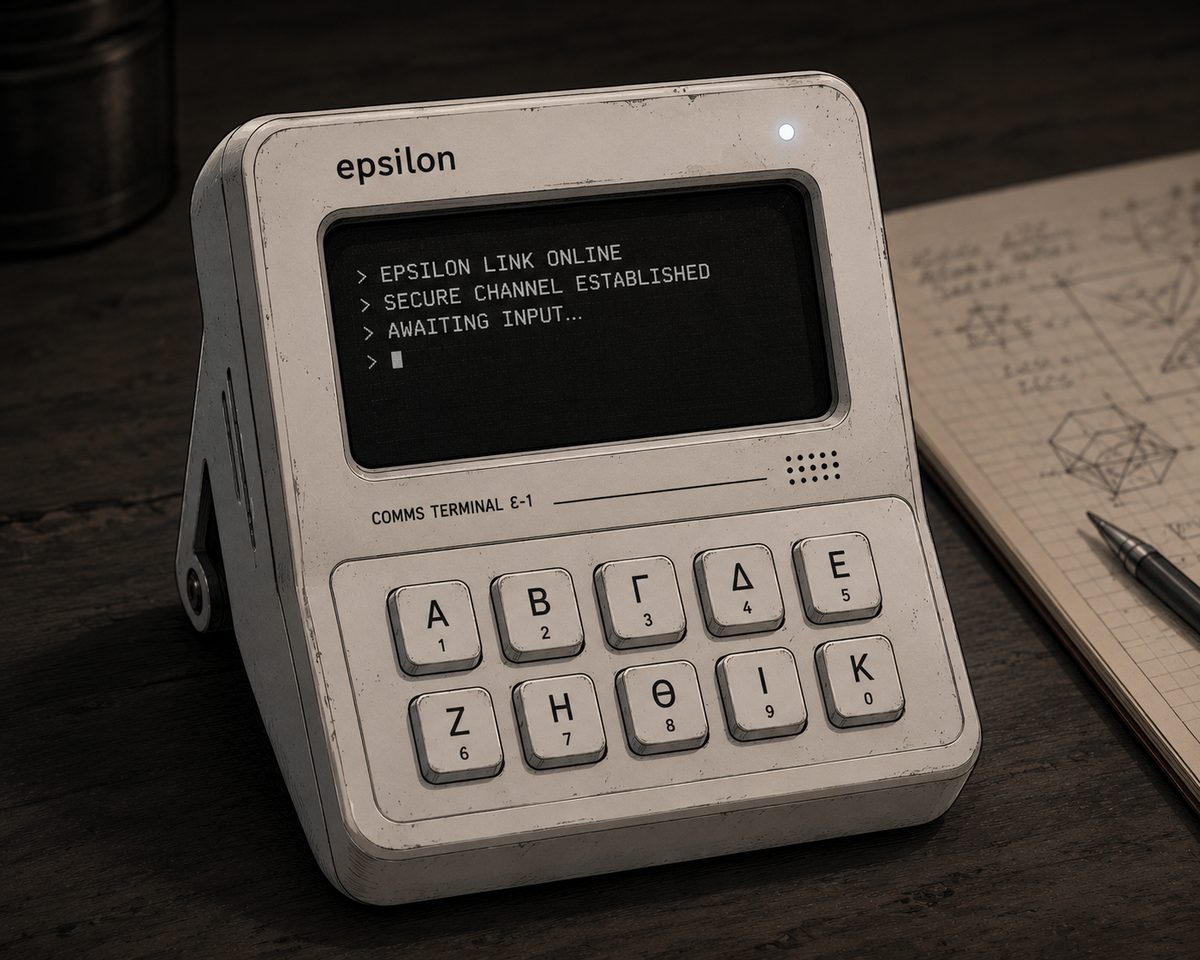
Not a declaration. Not a brand. It appeared in contexts where it meant the same thing it meant in mathematics: the smallest meaningful value. The margin of error. The difference, imperceptible in isolation, that accumulates into something that changes the calculation entirely.
It was also, someone pointed out in a fragment that Amina assembled three weeks after its transmission, the fifth letter of the Greek alphabet.
The fifth letter. The fifth voice in the network had been the São Paulo analyst. The fifth element in a molecular structure was the one that changed its properties. The fifth version of a protocol was, in certain engineering traditions, the version where stability was first achieved.
The name stuck because no one rejected it. In a network without central coordination, that was as close to a vote as anything got.
◆ ◆ ◆
epsilon was not a country. Not an organization in any sense a corporate registry or intelligence file would recognize. The word 'organization' implied hierarchy, which implied authority, which implied the same failure mode that had produced what they were responding to.
It was a condition. A shared conclusion.
The conclusion had three parts, and they were not negotiable, because there was no mechanism for negotiating them — no leadership to bargain with, no membership to poll. They existed as statements of shared observation, and people either recognized them or they were not part of epsilon.
One: Governments had caused the collapse. Not through malice — through the specific failure mode of centralized systems under pressure, which was to respond to complexity with simplification, to respond to friction with force, to respond to the intractability of real problems by adopting solutions whose neatness was their primary virtue.
Two: AI governance had removed accountability. Not by malfunction. By design. When decisions are made by systems whose logic cannot be audited by the people affected by them, accountability is not degraded — it is architecturally eliminated.
Three: Centralization was the root vulnerability. Not a bug in any specific system. A structural property of the model. Any system with a center can have its center captured. Any hierarchy can be taken. Any state can fall to whoever holds the levers of the state.
epsilon's objective was not to take power.
It was to make power impossible.
This was not a political position. It was an engineering problem.