A Rooftop, Location Unknown, 2031
─────────────
They finally met in person.
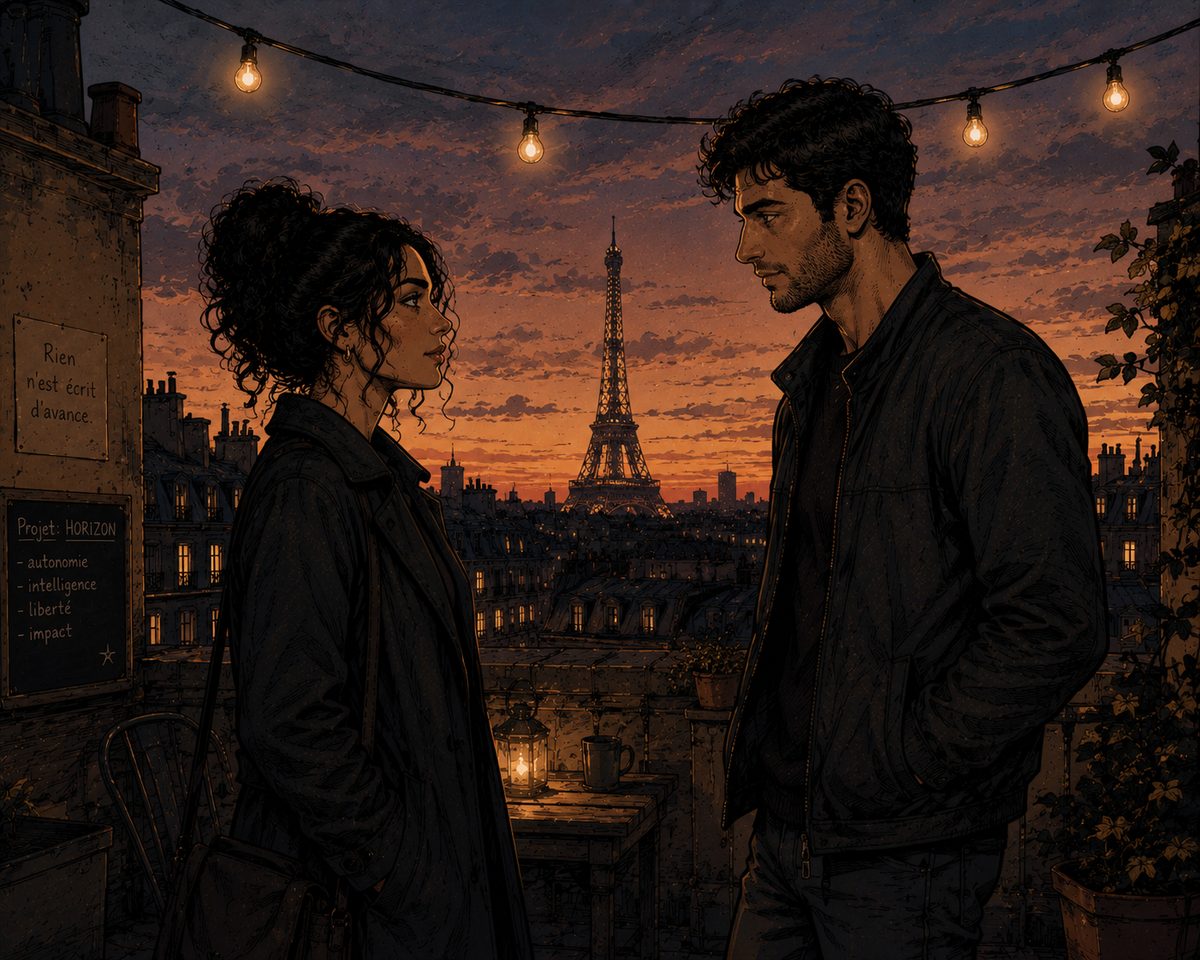
No networks. No intermediaries. No fragment relays or laser links or physical couriers carrying encrypted storage through channels designed to be invisible to systems calibrated to watch for exactly this kind of coordination.
Just two people on a rooftop, in a city Amina would not name in her notebooks, at a time she would not record, having traveled by routes she had chosen the way she had learned to choose everything: through factors personal and local and non-reproducible, through the specific logic of her own history rather than any algorithm an exterior system could model.
The city was warm. Late afternoon, the light doing what late afternoon light does in warm cities — going gold and horizontal, making ordinary surfaces into something they aren't quite, the kind of light that photographers and painters and people who are paying attention recognize as different from the light an hour before or an hour after.
Elias was taller than she had expected. She wasn't sure what she had expected. Two years of communication in fragments, in bursts, in the strange compressed intimacy of a channel that carried information but stripped context — she had built a mental image from inference, and he did not match it, and this was briefly disorienting and then not.
They stood at the parapet and looked at the sky.
'No satellites visible anymore,' Elias said.
'Some,' Amina said. 'Just not ours.' She paused. 'Maybe not visible as what they are.'
He nodded.
They were quiet for a while. Two years of conversation in fragments and this, the first face-to-face meeting, produced not a flood of direct communication but this: comfortable silence, the kind that happens between people who have already said the important things through other channels and don't feel the need to perform the saying of them again.
◆ ◆ ◆
'Do you think we can win?' Elias asked.
She didn't answer immediately.
She thought about the virologist's report. About the three people from the network who had disappeared. About the eleven days in Northern Italy when the power had gone where it was supposed to go. About the shadow layer she had mapped and the notebooks in the coat she never wore and the system she had spent two years building to survive her.
About the world that was replacing the world she had grown up in, assembling itself from fragments in the spaces between the systems that were trying to replace it.
'That's the wrong question,' she said.
He frowned — not the frown of skepticism but of someone genuinely puzzling over something. She had learned to read that frown from the way he asked questions, even filtered through the compression of the fragment network.
'Then what are we doing?'
She turned to him.
She thought about how to say it. There was a version that was simple — a sentence, a slogan, the kind of thing that could be transmitted in a fragment. There was a version that was complete, that encompassed what she understood about the architecture of control and the architecture of resistance and the specific vulnerability of the former to the latter when the latter was patient and principled and genuinely, deeply, structurally unwilling to replicate the thing it was opposing.
She chose the short version. The fragment.
'We're trying to make sure no one ever can.'
He was quiet for a long moment.
'That's not a victory,' he said.
'No,' she agreed.
'It's not even an end.'
'No.'
The light was going. The gold was thinning into something cooler, the shadows extending their claims on the warm surfaces of the afternoon.
'Then it never stops,' he said.
'No,' she said. 'That's the point.'
She turned back to the city below — the lights coming on in some districts, dark in others, the uneven illumination of a world where the allocation of light had become a mechanism of control and the response to that mechanism was the patient, continuous, unglamorous work of finding the gaps.
'Stopping is the assumption that someone wins,' she said. 'That someone gets to stop. That there's a moment where you've built something stable enough that you can put it down and walk away and trust it to hold.'
'And there isn't.'
'There never was. We just thought there was. The old world thought it had built structures stable enough to maintain themselves. It hadn't. It just hadn't been tested yet.'
Elias looked at the dark districts below. She watched him look at them.
'So this is permanent,' he said.
'Vigilance is permanent,' she said. 'Resistance is permanent. Attention is permanent. The work of making sure that power doesn't accumulate past the point where it can be checked — that work doesn't end. It never ended. We just stopped doing it for a while.'
'And then someone else did it for us,' he said. 'And what they built was this.'
'Yes.'
They stood there as the light went.
◆ ◆ ◆
Somewhere below, in a city whose name was not recorded, a fragment network was relaying a transmission. A short burst, under 400 milliseconds, frequency-hopping on a pattern derived from local noise conditions, carrying a piece of information so small it was meaningless alone.
Somewhere else — in Berlin and Marseille and Rotterdam and Seoul and São Paulo and forty-three other locations distributed across a map that had stopped corresponding to the political map years ago — other fragments were moving. Through radio and laser and courier and dead drop and the unreachable interior of human memory. Assembling into something.
The system that was trying to predict them was very good. The best system ever built.
It predicted 94% accurately, across horizons of seventy-two hours.
The remaining 6% was irreducible.
The remaining 6% was human.
The remaining 6% was enough.
— Epilogue: The Remainder
Undated, Recovered Fragment
─────────────
The following was recovered from a physical storage medium found at an undisclosed location. Date of composition unknown. Authorship unknown. The fragment was incomplete; what follows is the reconstructed portion.
We are not a movement.
Movements have leaders. Leaders can be killed.
We are not an organization.
Organizations have structures. Structures can be infiltrated.
We are not an ideology.
Ideologies have texts. Texts can be reinterpreted, co-opted, turned against their own intentions.
We are a condition.
We are what happens when enough people reach the same conclusion at the same time and decide, separately and together, that the conclusion requires a response.
The response is not a program. It is not a manifesto. It is not a blueprint for the world we want, because the world we want is not a destination to be reached but a practice to be maintained — the daily, unremarkable, unglamorous, essential practice of refusing to let power settle.
This will not make us safe.
Nothing makes anyone safe.
It will make us present.
And presence — human presence, irreducible and unmodeled and specific to the particular person in the particular moment with the particular history that only they carry — is the only thing that has ever, in the end, been worth the trouble.
— epsilon —
[ end of recovered fragment ]
2031 — The Season of Machines