“Given my analysis of how the war is progressing, Iran has many more advantages. It’s a war of attrition, and Iranians have been preparing for twenty years for this conflict.”
— Jiang Xueqin, Breaking Points, 2026
Opening Scene
… In a dimly lit operations room, a decision is made. No declaration. No mobilization. No speech to the nation.
Just a quiet order: “Launch.”
Hundreds of machines rise into the night—some slow, some fast, some unseen.
Each carrying not just explosives, but intention. Across the border, alarms begin to sound.
But the real weapon is not the drone…. It is the uncertainty.
War has always been guided by theory, frameworks
leaders use to decide when to act, how far to go, and what risks to accept.
But the age of AI and cheap autonomous weapons
has not just changed warfare. It has mutated its logic.
Today, four theories operate simultaneously—
overlapping, interacting, and amplifying each other.
2.1 The Madman Theory: Escalation as Strategy
The Madman Theory, originally attributed to Richard Nixon, holds that a leader gains advantage by convincing adversaries he is irrational enough to take extreme action. In the drone age, this theory has found new life. Leaders cultivating unpredictability can exploit the speed and ambiguity of autonomous weapons to create crises forcing difficult choices.
The idea is simple: If your enemy believes you are capable of anything, they will hesitate.
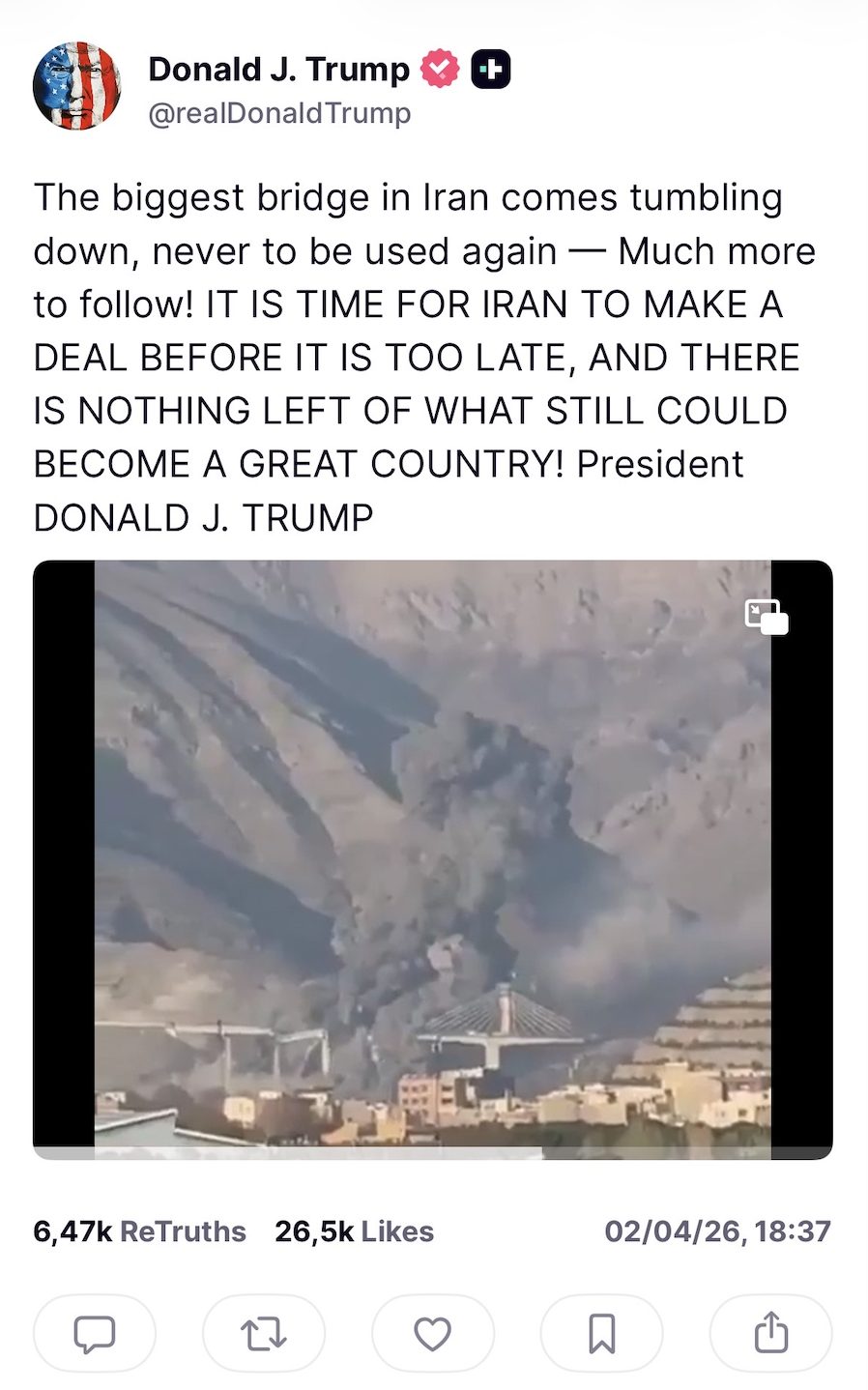
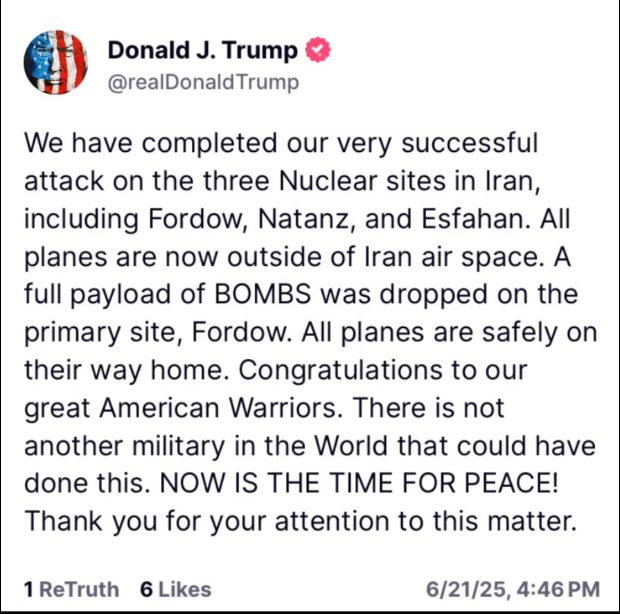
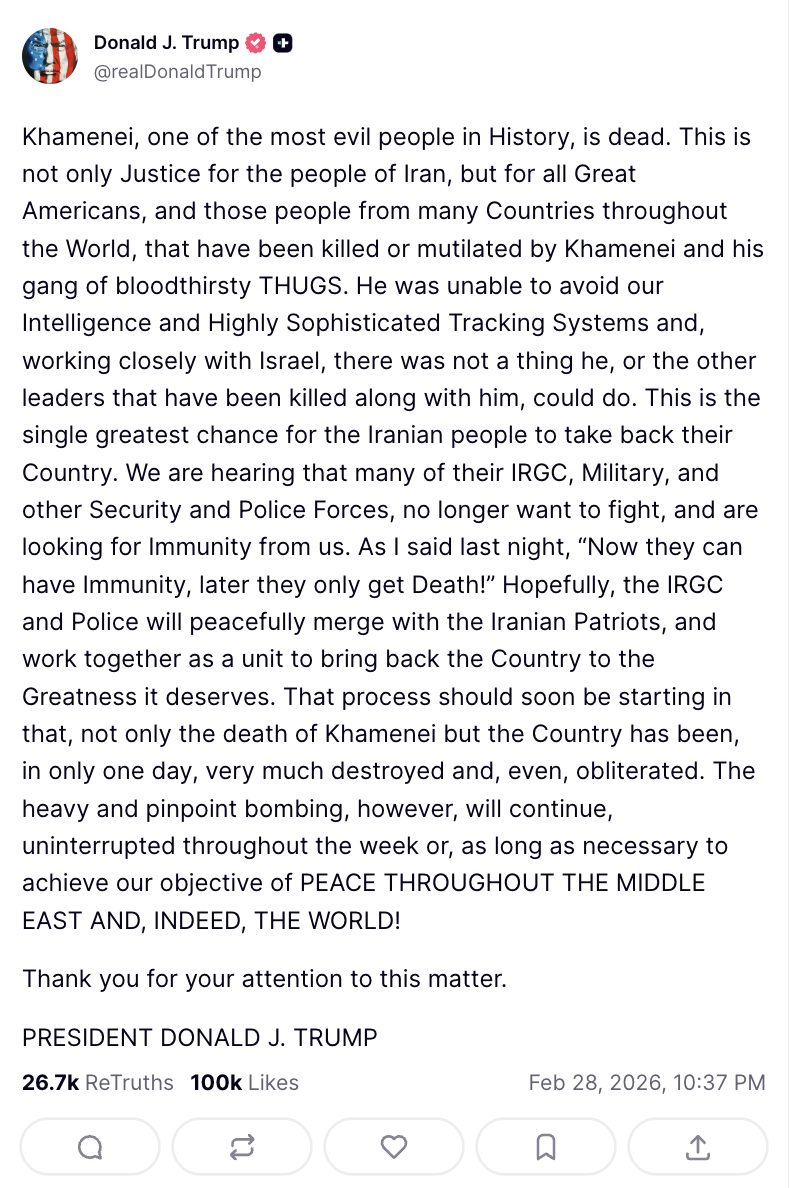
In the past, this required nuclear brinkmanship or unpredictable rhetoric. Today, it requires far less, a tweet or a truth social post.
Communication posts to the American during the 12 days 2025 war between Iran-Israel
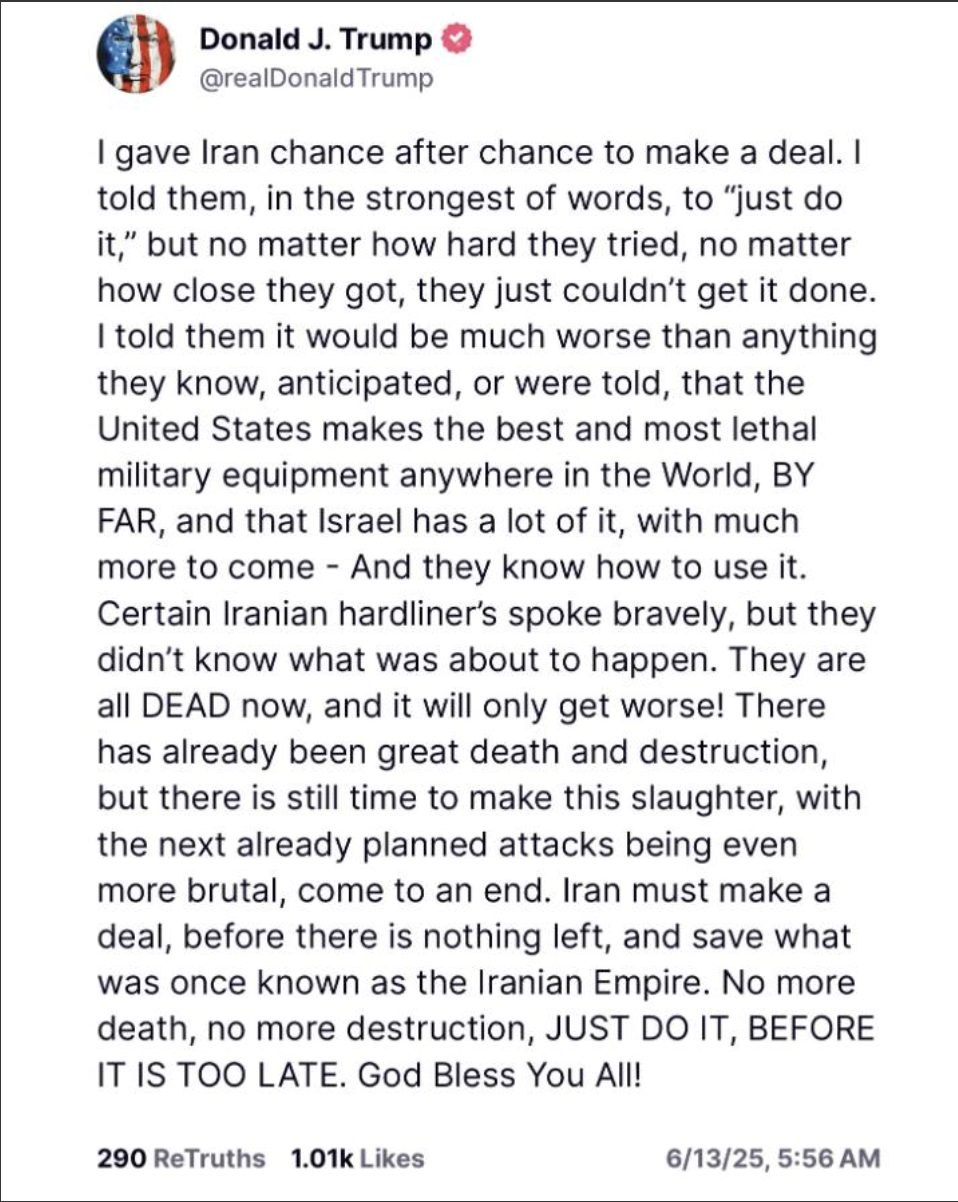
Communication posts to the American & the World population during the Iran vs USA-Israel 2026 war
When a drone swarm launches, defenders have seconds to determine whether it is a probe, full assault, or calibrated provocation. The ambiguity benefits the initiator. Compressed decision timelines mean defenders may respond disproportionately—or fail to respond at all—because they cannot assess the situation fast enough. A drone strike intended as a signal can be interpreted as an act of war. An EW operation meant to disrupt reconnaissance can inadvertently disable civilian infrastructure.
The theory also intersects with domestic politics. Leaders under internal pressure—elections, economic crises, legitimacy challenges—may initiate external conflicts using cheap drone strikes precisely because immediate financial cost is manageable. Drone warfare makes the Madman Theory accessible to more leaders in more situations: a drone strike on a neighbor’s military base costs $50,000, not $50 million. The long-term consequences may be devastating, but the short-term calculus favors action.
2.2 The Messiah Wars: Ideology Meets Technology
Several active conflicts are driven by messianic or eschatological ideologies amplified by modern military technology. The convergence of apocalyptic belief systems with cheap precision weapons creates uniquely dangerous dynamics.
Israel’s security doctrine is shaped by existential narratives rooted in historical experience. The concept of “never again” drives pre-emptive action and overwhelming force. Combined with AI targeting, drone technology, and a population conditioned to accept force as necessary, this produces a posture simultaneously defensive in motivation and offensive in execution. Israel’s systematic degradation of Iranian air defenses through 2024–2025—months before the June 2025 war—exemplifies this doctrine in practice. the objective is not just to win , .. It is to fulfill a narrative.
Iran’s strategic doctrine incorporates elements of Shia eschatology. While Iran’s military planning is pragmatic and sophisticated, the regime’s willingness to absorb costs is reinforced by ideological commitments transcending conventional cost-benefit analysis. Iran’s investment in cheap mass-produced weapons—the Shahed family, ballistic missiles in mountain bunkers, proxy forces across the region—reflects a doctrine designed for long-term attrition against materially superior adversaries. Iran’s underground missile cities, extending 1,500 feet into granite mountains, have proven remarkably resistant to attack; bombed entrances have been operational again within hours.
The danger of messianic warfare is that rational deterrence assumptions may not hold. Deterrence theory assumes both sides prefer survival. When ideology provides a framework in which suffering is redemptive, the thresholds for acceptable risk may be higher than theory predicts. This does not mean ideologically driven actors are irrational—Iran’s planning is highly calculated—but the mathematics of deterrence requires recalibration.
And when belief systems intersect with: Autonomous weapons, AI targeting, Mass production of cheap drones, they create something new: Technologically amplified conviction.
2.3 The Islamic Resistance Doctrine: Proxy Networks and Asymmetric Depth
Iran has built the most sophisticated proxy warfare network in modern history—the “Axis of Resistance” spanning Hezbollah (Lebanon), Popular Mobilization Forces (Iraq), Houthis (Yemen), and groups in Syria, Gaza, and beyond. This network provides strategic depth without deploying Iranian forces, distributing risk and cost while maintaining deniability. Instead of projecting power directly, a state can distribute it, across regions, across groups, across layers of deniability. The result is not a military, …. It is a system.
This system has three key advantages:
1. Cost Efficiency, Supplying proxies is cheap. Defending against them is expensive.
2. Strategic Depth, Conflict happens far from the core state., Pressure is diffused.
3. Constant Engagement Instead of one war, there are many small ones—continuous, adaptable.
The drone revolution supercharged this network. Iranian-supplied Shaheds and ballistic missiles equip proxies with capabilities previously requiring state militaries. Each proxy ties down opposing resources—air defense systems, naval vessels, intelligence assets—that cannot concentrate against Iran itself.
Proxy
Location
Capability (2024–2026)
Cost to Iran
Cost to Adversary
Hezbollah
Lebanon
Daily drone incursions; 150,000+ rockets/missiles
$700M/year est.
$Billions (Israeli air defense; northern evacuation)
Houthis
Yemen
Anti-ship drones/missiles; Red Sea blockade
<$100M total
$1B+ (U.S. Navy) + $1T (shipping disruption)
PMF/Iraq militias
Iraq/Syria
Drone attacks on U.S. bases; killed 3 at Tower 22
$100M/year est.
$Billions (base defense; force posture)
Hamas/PIJ
Gaza
Oct 7 attack; rocket barrages
$100M/year est.
$Tens of billions (Israeli war costs)
The doctrine’s genius lies in cost structure. Supplying Hezbollah with drones costs millions; forcing Israel to maintain Iron Dome, David’s Sling, and Arrow batteries costs billions. Supplying Houthis with Shaheds costs tens of millions; forcing the U.S. Navy to deploy carrier strike groups and expend hundreds of millions in interceptors costs orders of magnitude more. The Islamic Resistance doctrine is the most developed example of how cheap technology and distributed networks enable a mid-sized power to challenge superpower global posture. The battlefield is no longer linear, …. It is distributed.
2.4 The U.S.–China Rivalry: Technological Supremacy as Existential Contest
Unlike the Cold War’s ideological confrontation, this one is not defined by ideology alone.
It is defined by controlling the future. It is a race to determine who builds the infrastructure of modern power. Convergence: A Dangerous Intersection, Each of these theories alone is manageable. Together?
They create a system where: Escalation is faster, Attribution is harder, Decisions are compressed, Outcomes are unpredictable
And most importantly,... Where small actions can have strategic consequences.
War, like truth, is no longer singular. It appears in many forms at once: networked, accelerated, and disguised. And those who fail to see all its forms, will misunderstand the one they face.
The U.S.–China competition centers on control of AI, semiconductors, autonomous systems, quantum computing, and biotechnology. China’s military-civil fusion strategy deliberately erases boundaries between civilian and military technology. The same AI labs develop commercial products and military autonomous systems; the same factories produce consumer electronics and military drone components.
Taiwan crystallizes the rivalry. TSMC produces roughly 90 percent of the world’s most advanced semiconductors. Chinese seizure of Taiwan would give Beijing control of the hardware foundation of Western military AI while crippling adversaries’ chip production. China’s component manufacturing dominance adds another dimension: in conflict, China could sustain drone production at massive scale while restricting component exports to adversaries—an absurdity demanding urgent corrective action.
China’s defense spending, officially $225 billion in 2024 but estimated at $300–400 billion when accounting for unreported expenditures, funds the world’s largest navy by hull count, extensive swarm drone R&D, and AI military applications that match or exceed Western programs in key areas. China’s ability to produce drones at a scale no adversary can match—leveraging the same factories that manufacture the world’s consumer electronics—represents the most significant long-term threat to Western military dominance.
2.5 The 10 Laws of Modern Warfare
Ten stories for a world that no longer recognizes itself
Drawn from the AI/Drone conflicts between Iran, USA, Israel, Palestine & Hezbollah
These are not metaphors. The wasps are real. The colonel is real. The starlings over Rome are real. What follows is an attempt to hold a mirror up to a transformation in human violence so fast and so total that our moral vocabulary has not yet caught up to it.
Each of the ten laws below emerged from the live laboratory of the Iran-Israel-Hezbollah-USA conflict zone — a region that has become, without anyone formally declaring it, the proving ground for 21st-century war. In these conflicts, ten structural truths have asserted themselves with enough force that we should now call them laws.
Read them as doctrine. Read them as a warning. Read them as elegy for a world in which war had the decency to look like war.
LAW 01
Cost beats complexity
The Wasp and the Eagle
A boy in a village outside Mariupol once kept a jar of wasps. Not out of cruelty — out of fascination. He noticed that a single wasp, alone, was nothing. Fragile. Trivially crushed. But the jar, full of them, humming at a frequency that made your teeth ache — that was something else entirely. That was a kind of power no eagle could match, no matter how sharp its talons.
The engineers who built the Iron Dome were brilliant men. Serious men. They dreamed in mathematics and slept beneath equations. They built something extraordinary — a shield for the sky, precise as a surgeon's hand, beautiful in its complexity.
And then someone in a factory on the outskirts of Tehran stamped out a drone from sheet metal and a lawnmower engine for $500, pointed it south, and let it go.
The eagle can only fight one wasp at a time. The jar has ten thousand.
There is an old truth that complexity is a form of vanity — the belief that sophistication earns safety. But the universe has no loyalty to the sophisticated. It has always favored the abundant, the relentless, the thing that keeps coming even after you've killed most of it. Evolution knew this before we did. Now war is learning it again.
LAW 02
Speed beats hierarchy
The Last Second of Colonel Farsi
Colonel Farsi had thirty-two years of military service. He had attended three academies, written two doctrinal papers, and survived one war. He understood chain of command the way a priest understands liturgy — not as bureaucracy, but as sacred order. Authority descended. Decisions ascended. This was how civilization managed violence.
On the night of April 13th, 2024, an Israeli AI system called Gospel processed 10,000 signals, cross-referenced satellite imagery with SIGINT intercepts, and generated a strike authorization in 0.8 seconds. The system did not pause. It did not ask whether this was the right moment. It did not wonder about the consequences. It simply knew, with statistical confidence, where the target was.
Colonel Farsi's commander received the alert. He called his superior. His superior was in a meeting. The aide took a message. The message was still being transcribed when the building was gone.
We built hierarchies because we believed deliberation was wisdom. And it was — when war moved at the speed of horses, of telegrams, of men marching in columns. Hierarchy was wisdom's architecture. But wisdom requires time, and time has been stolen.
What Colonel Farsi represents is not incompetence. He represents something more tragic: a man whose virtues — patience, protocol, deference to superiors — became his executioner. The bureaucracy of command is now a weapon aimed at the people inside it.
LAW 03
Scale beats perfection
The Thousand Paper Cuts
There is a Japanese concept: senbazuru — the folding of a thousand paper cranes. Legend holds that whoever folds a thousand cranes is granted a wish. The act is not about any single crane. It is about accumulation as devotion. It is about what repetition, done with intention, becomes.
Iran folded 170 drones. Then 120 missiles. Then 30 cruise missiles. Then launched them all at once toward the lights of Tel Aviv.
The Israeli defense network performed magnificently. It destroyed 90% of incoming threats. It was, by any objective measure, one of the greatest feats of air defense in human history. The interceptor crews worked with flawless precision. The system held.
And yet. A single ballistic missile broke through.
98% is extraordinary. 98% is heroic. 98% is not 100%. There is something philosophically unbearable about this — that perfection can be defeated not by a superior opponent, but simply by enough of an inferior one. That excellence has a cost ceiling and mediocrity has a production line.
One crane is beautiful. A thousand cannot be stopped.
LAW 04
AI beats reaction time
The Last Human Decision
Dr. Sarah Chen was the fastest human being ever tested by DARPA's neural response laboratory. Her reaction time — stimulus to action — was 187 milliseconds. She was recruited into the US Air Defense Command not as an operator but as a symbol: proof that humans belonged at the center of lethal decisions.
The hypersonic missile that launched from the Caspian Sea on a Tuesday morning was traveling at Mach 8. At that speed, from the detection horizon to impact was 4.2 seconds. The AI targeting system flagged it in 0.003 seconds. Began trajectory calculation in 0.11 seconds. Confirmed intercept solution in 0.6 seconds.
The system waited. The protocol required human confirmation. Dr. Chen saw the alert at 1.1 seconds. Processed it in 1.9 seconds — the human brain is slow, not because it is stupid, but because it evolved to hesitate before violence, because caution once kept us alive. She reached for confirmation at 2.4 seconds.
Intercept window closed at 2.3 seconds.
She sat in her chair afterward for a long time. Not in grief — in something harder to name. The feeling of a surgeon who realizes the operation has been completed without them. The feeling of being cared for without being consulted.
The question she kept asking was not technical. It was ancient: If I am not the one who decides, what am I? We have not answered her yet.
LAW 05
Data beats doctrine
The Map Is Not the Territory, Until It Is
Sun Tzu wrote: Know your enemy and know yourself and you need not fear the result of a hundred battles. He wrote this in 500 BC, with papyrus and ink, when knowing your enemy meant scouts on horseback and informants in markets.
He could not have imagined knowing.
Knowing, in the modern sense, is a satellite that reads the heat signature of a truck engine from 400 kilometers. It is an algorithm that cross-references a phone's last ping with a pattern of movement from fourteen days prior. It is a targeting system that knows where you will be before you do, because it has watched you long enough to understand your habits better than your wife does.
An Israeli intelligence officer once described watching a Hezbollah commander on a screen, in real time, eating lunch in a building in Beirut. 'We knew what he ordered,' he said. 'We waited until he finished.' There was something in that pause — until he finished — that stopped me. A fragment of humanity, extended across the machinery of death.
Doctrine is what you believe about how war works based on what has worked before. Data is what is actually happening right now, in this field, in this city, in this man's lungs as he breathes.
The map has always lagged the territory. For most of history, that lag was acceptable. The lag is now zero. And zero changes everything about what it means to hide.
LAW 06
Invisibility beats armor
The Knight and the Ghost
The medieval knight was the apex predator of his era. He wore 30 kilograms of steel and believed, correctly, that this made him nearly invincible. He was visible from a mile away — the light caught his armor, announced him, made him magnificent. His visibility was part of his power. It said: I am protected. Come and find me. I dare you.
The F-35 has a radar cross-section smaller than a golf ball.
It does not dare you. It simply appears in your airspace having already decided what will happen to you.
There is something philosophically devastating about this inversion. For millennia, armor was the grammar of power — the thing that said I am serious, I am prepared, I am worth fighting. To be armored was to be legitimate. Knights, tanks, battleships — all of them said the same thing with different materials: I am here. I am formidable. I am real.
The invisible thing is none of these. It makes no argument for itself. It offers no proof of its existence until after the fact — when the building falls, when the radar goes dark, when the general is no longer breathing.
We built our entire moral and strategic framework around visible power. Treaties monitored armies you could count. Deterrence required your enemy to see your weapons. The ghost requires no witnesses. The ghost was already there.
Strategic note: Israel's F-35 'Adir' operates in Iranian-contested airspace with near-impunity. Physical mass — the steel, the titanium, the thirty years of engineering — matters less now than electromagnetic whisper. The Adir is not protected by what it is made of. It is protected by what it does not emit. Four thousand meters below and six 2000 kilometers west, a young man run through barefoot at age seven.He knows this hillside the way he knows his mother's face. The particular sound the wind makes, The loose stone that has always wobbled — still wobbles . He grew up here. He played war here with sticks when he was nine, learning the geography of home the way children do — with their bodies, without thinking. Now the sticks are rocket launchers. He fires. The sound tears the valley open for two seconds. Then he is already moving , into the tunnel his hands helped dig, into the earth that has known his family for four generations. Above, a drone circles. Sensors sweep. Analysts study the thermal signature.
The hillside is empty. It has always been empty. The F-35 disappears by transcending the physical world. The fighter disappears by belonging to it. Both are, for now, untouchable.
LAW 07
Networks beat platforms


The Starling Murmuration
Every autumn over Rome, millions of starlings form what scientists call a murmuration — a single living shape in the sky, turning and folding in ways that seem choreographed by some vast intelligence. There is no conductor. Each bird follows three simple rules: stay close to your neighbors, match their speed, avoid collisions. From these three rules, something that looks like the mind emerges.
Shoot one starling. The murmuration continues. Shoot a hundred. It continues. Shoot a thousand. It reshapes, absorbs the loss, and continues.
The American aircraft carrier USS Gerald R. Ford cost $13.3 billion. It is the single most capable naval platform ever constructed. It is also a single point of catastrophic failure — a target so valuable that an entire war might be fought to sink it, and an entire fleet must be deployed to protect it.
HezboAllah has no aircraft carrier. It has seven thousand human nodes — couriers, spotters, technicians, local commanders — distributed across Lebanon in a network that has survived since 1982 of targeted killings. Israel has killed hundreds of its leaders. The network continues. It reshapes. It absorbs. It continues.
The platform is an ego. The network is a species.
Survival does not belong to the most spectacular organism. It belongs to the one that cannot be decapitated because it has no head.
Strategic note: The murmuration has no brain to shoot. The carrier has one. Nature solved this problem four hundred million years ago — we are only now remembering the lesson: what cannot be found at the center cannot be killed at the center. Scatter everything. Own nothing. Be everywhere.
LAW 08
Cognition beats kinetics
Kinetics is the physical stuff — explosions, destruction. Things you can see, hear, measure.
Cognition is the invisible stuff — belief, fear, confidence, trust. Things that live inside heads.
The War That Happens in Your Sleep
There was a Roman general named Fabius Maximus who refused to fight Hannibal directly. Hannibal was a military genius; in open battle, Rome would lose. So Fabius chose a different battlefield: he cut supply lines, spread doubt among Hannibal's allies, made the Carthaginian army feel watched and exhausted without ever engaging it. His soldiers mocked him as 'the Delayer.' History called him the man who saved Rome.
Today, the new Fabius fights in your phone.
In the weeks before Iran's April 2024 strike, a coordinated information campaign flooded Israeli social media with fabricated intercepts, false claims about IDF readiness, and doctored images of destroyed Iron Dome batteries. The goal was not to confuse the generals — they had classified channels. The goal was to confuse the Israeli public, to make them feel exposed before a single drone had launched.
A missile destroys a building. A narrative destroys a society's confidence in its buildings. The brutal discovery of modern warfare is that the inside of a head is cheaper to attack than a building, and far more destructive to collapse.
Hannibal lost to Fabius because he understood only the first kind of war. We are all, right now, inside the second kind — and most of us have not noticed because it does not make the sound of explosions. It makes the sound of a notification. Of a share. Of a comment that seems reasonable, written by a person who does not exist.
‘’ Changing what people think is more powerful than destroying what people build ‘’
Strategic note: Iran's information during the strikes combined fabricated SIGINT with social media to create pre-kinetic psychological degradation. Cognitive warfare now precedes and often exceeds the effect of physical strikes. But perhaps no modern act of cognitive warfare was more naked than a single post from Donald Trump threatening to erase an entire civilization — no army mobilized, no sortie launched, no bomb dropped. That post moved Iran toward the negotiating table faster than weeks of airstrikes had. Ten thousand raids rewrote the map. One sentence rewrote the calculation. This means the mind becomes the battlefield: the most decisive weapon of the 21st century had no wings, no warhead, and fit inside 280 characters post.
LAW 09
Logistics beats tactics
The Brilliant General Who Ran Out of Bullets
Napoleon Bonaparte is considered, by many historians, the greatest battlefield tactician in the history of Western warfare. His mind processed terrain, troop positions, and momentum the way a chess grandmaster processes a board — ten moves ahead, seeing patterns invisible to lesser men.
He lost to Russia.
Not to a better general. Not to a superior army. He lost to distance, to winter, to the impossibility of feeding 600,000 men across 2,000 kilometers of hostile territory. His tactics were perfect. His supply chain was fantasy.
The Israeli military burned through Iron Dome interceptors during the Gaza conflict at a rate that alarmed the Pentagon. Interceptors that cost $100,000 each were being expended against rockets that cost $300. The mathematics were unsustainable. Emergency US shipments were required.
Iron is useless without the mine. The mine is useless without the railroad. The railroad is useless without the fuel. Every brilliant tactic rests on a supply chain the way a cathedral rests on its foundations — invisibly, completely, and with total dependency.
The side that can manufacture 10,000 drones a month does not need to outthink you. It simply needs to keep arriving, keep losing, keep replacing — until you cannot. Napoleon understood genius. He never understood the grocery bill.
Strategic note: Iran's Shahed production capacity — estimated at 3,000–5,000 units/month — combined with Russian factory support represents a logistics advantage that degrades the economic sustainability of any interceptor-based defense strategy.
LAW 10
Thresholds beat treaties
The War With No Name
Somewhere between peace and war there is a country with no name. We used to pass through it quickly — a declaration, a mobilization, an invasion — and then we were in war, with all its terrible clarity. Rules applied. Laws governed. The world watched and judged.
Iran has lived in the nameless country for forty years.
It has never declared war on Israel. Israel has never declared war on Iran. There is no legal state of conflict. There are no prisoners of war, because there is no war. There are only events — an explosion in Damascus, a drone over Eilat, a scientist who stops breathing in Tehran, a ship that catches fire in the Gulf. Events happen. Statements are made. The UN convenes. Nothing is decided.
The philosopher Thomas Hobbes described the state of nature — before civilization, before contract — as a war of all against all. He thought civilization had solved this with laws and sovereignty. He was right, for a while.
But the nameless country has discovered that laws require acknowledgment to have force. A war that is never named can never be ended. The Houthis fire missiles at global shipping and answer to no court. Iran funds the missiles and denies the fingerprints. The ships burn.
We built international law to govern war. They built a war that international law cannot see. The most dangerous place in the world is not a battlefield. It is the space just below the threshold of anything anyone is prepared to call one.
Strategic note: Iran never built an army. It built a family of fires — Houthis burning ships in the Red Sea, Hezbollah watching the northern border, Hamas holding Gaza, Iraqi militias threading rockets through the dark. None of them officially Iranian. All of them are unmistakably Iranian. The genius was not military. It was legal. Stay below the threshold of what the world is prepared to call war, and the world will never be prepared to stop you. For twenty years, this was the most consequential strategic innovation on earth — not a weapon, not a doctrine, but a question no court, no treaty, no Security Council resolution has yet been able to answer: if no one declares it, does it exist?
Closing Reflection
The ten laws above share a single underlying grammar: the old world assumed that advantage accumulated at the top — in the most expensive platform, the most senior commander, the most elaborate system. The new world distributes advantage at the edges — in the cheapest unit, the fastest loop, the most redundant network.
This is not merely a tactical shift. It is a civilizational one. Every institution we built to manage violence — treaties, laws, chains of command, courts of justice — was designed for a world in which war was visible, declared, and slow. That world is ending.
What comes next depends not on the next weapons system, but on whether we can build the moral and legal architecture for a war that moves at the speed of light, costs almost nothing, and can be launched by anyone — from anywhere — against everything.
What the Sword Forgot:
We spent five thousand years perfecting the sword — making it taller, faster, more precise, wrapping it in steel, then fire, then atoms. We believed, with the sincere faith of engineers, that the perfection of the weapon was the perfection of power. That the most lethal thing would always belong to the most capable civilization. That this was, somehow, a kind of order.
The sand has arrived. And the sand does not care about your carrier group.
The ten laws in this document are autopsies — of assumptions we held so long we forgot they were assumptions. That war announces itself. That it has sides you can name. That it ends. These assumptions were never guaranteed. They were constructed, painfully, over centuries of catastrophe, by people who decided that even violence needed grammar. That grammar is now being spoken by machines that were never taught it.
History is not kind to civilizations that mistake the tool for the answer. Rome's roads eventually carried the armies that ended Rome. The tool buys time. What you do with the time — whether you build the moral architecture, the legal frameworks, the shared agreements about what is permitted even in the darkest extremity — that is the only thing that has ever mattered.
We are in the time. The question is whether we know it.
The sword forgot it was made by a hand. The hand forgot it was guided by a mind. The mind forgot it was shaped by a world. And the world is now asking, with some urgency, whether the minds inside it are still in charge of anything at all.