📜 “The intellect is a light, but the heart sees what it cannot.” — Ibn Al-Arabi
In giving machines the power to decide, we extend our intellect but risk losing our wisdom.
And in that gap, the future of war will be decided.
Opening Scene :
The drone loses signal.
For a brief moment, it drifts.
In the past, that would have been the end. A lost link. A failed mission.
But this drone does not return.
It continues. It scans. It recognizes.
The image sharpens.
A figure appears.
The system highlights it.
The operator watches.
For a brief moment, it is just a person.
Then it becomes a target.
The decision takes seconds.
The memory will not.
No pilot. No command.
Only code.
4.1 From the gamer generation to active Actor
Artificial Intelligence is not just improving warfare. It is changing its nature.
In traditional combat: Humans detected > Humans decided > Humans actedMachines assisted.
Now: Machines detect > Machines decide > Machines act …. Humans supervise—sometimes.
This is not automation. It is a delegation of judgment.
Modern war creates distance, but not innocence. The further you are from the act, the harder it is to feel its weight but not erase responsibility. The screen protects the body, not the conscience.”
4.2 The Collapse of the Decision Chain: The AI Targeting Pipeline
Understanding the classic military sequence: Detection → Identification → Decision → Action . Was once measured in minutes. Sometimes hours.
AI compresses this into: milliseconds
Why this matters: Faster reaction than any human, No hesitation under stress, Continuous operation without fatigue. But the real shift is strategic: Speed becomes dominance. War becomes less about strength but more about processing speed.
This how AI transforms drone warfare requires examining the complete targeting pipeline—the chain of processes from initial detection to weapon impact. In a traditional FPV drone engagement, this chain is entirely human: the pilot detects a target through the camera feed, identifies it, decides to engage, maneuvers the drone, and guides it to impact. Every link in this chain depends on the radio connection between pilot and drone; sever that connection, and the weapon fails.
AI replaces each link with autonomous capability. A modern AI-enabled FPV drone operates through the following stages:
Stage
Human-Piloted
AI-Enabled
Advantage
Detection
Pilot scans video feed
Computer vision scans 360° continuously
No fatigue; wider search; IR/thermal capable
Classification
Pilot identifies target type
Neural network classifies (tank, vehicle, trench)
90%+ accuracy; millisecond speed
Priority selection
Pilot chooses target
AI ranks by pre-programmed priority rules
Consistent doctrine application
Engagement decision
Pilot decides to attack
AI recommends; human approves (or autonomous)
Speed; removes emotional hesitation
Terminal guidance
Pilot flies to impact via video
AI locks visual signature; guides autonomously
Immune to jamming; compensates for wind/maneuver
Link dependency
Continuous radio required
None after launch (fully autonomous mode)
Unjammable in final phase
Reaction time
~0.5–2 seconds (human)
~10–50 milliseconds
10–40x faster
The training pipeline for these AI systems mirrors commercial computer vision development but operates under extreme time pressure. Ukrainian developers built datasets from frontline footage—thousands of hours of drone video showing Russian equipment in operational environments. These images were annotated (marking tanks, vehicles, fortifications), augmented (rotated, scaled, color-adjusted to simulate different conditions), and used to train lightweight convolutional neural networks optimized for real-time inference on low-power chips.
The complete cycle from identifying a new target type to deploying an AI model capable of recognizing it could be as short as two weeks: one week for data collection and annotation, a few days for model training and validation, and a few days for integration testing and field deployment. This speed is possible because the models are relatively small (designed to run on chips costing $20–$50) and the training infrastructure uses commercial cloud computing resources. Compare this to a traditional military acquisition program’s requirement validation alone, which typically takes 12–18 months.
However … Who is responsible when AI decides ?
4.3 The Swift Breakthrough: Technical Implications
The University of Zurich’s Swift system, published in Nature in August 2023, represents a critical milestone. Swift beat world champion drone racers at speeds exceeding 100 km/h using only onboard sensors—no external tracking, no human pilot. The system architecture has direct military implications:
Technical Feature
Swift Implementation
Military Application
Visual localization
CNN maps camera images to gate positions
Navigate to targets using terrain/building recognition without GPS
Deep reinforcement learning
Self-taught in simulation; transferred to reality
Train attack profiles in simulation; deploy to real drones in hours
Onboard processing
All computation on the drone itself
No communication link needed; immune to all jamming
Reaction time
120ms average (vs. ~250ms human)
Faster than any human pilot; better at last-second maneuvers
Adaptability limitation
Failed when conditions differed from training
Needs robust training across conditions; current vulnerability
Training time
<1 hour desktop computing for flight mastery
Rapid deployment of new behaviors and target profiles
The military translation is straightforward: Swift’s technology enables a drone to navigate at extreme speed through complex 3D environments using only visual sensors and onboard AI. Replace the racing gates with buildings, trees, and terrain features; replace the goal of finishing a lap with the goal of reaching a GPS coordinate and finding a target matching a visual profile; and you have an autonomous precision weapon capable of operating in environments where GPS is jammed, radio links are severed, and human pilots would be overwhelmed by the speed and complexity of the environment.
The reinforcement learning approach is particularly significant. The AI learns optimal behavior through millions of simulated attempts, discovering maneuvers and strategies that human engineers might never design. The simulation-to-reality transfer technique—using real-world data to calibrate the simulator so that simulated behaviors transfer accurately to physical drones—means that new behaviors can be developed, tested, and deployed without ever crashing a real drone during training.
4.4 Electronic Warfare: The Invisible Contest vs Algorithmic
Electronic warfare once offered a solution: Jam the signal → stop the drone. But AI breaks this logic. A fully autonomous drone: Does not need GPS, Does not need communication, Does not need a humanIt navigates using Vision, Pattern recognition, Environmental mapping. And this creates a new reality: You cannot jam intelligence.
The battlefield shifts from: Electromagnetic control to: Algorithmic superiority
The electromagnetic spectrum has become the most contested domain in the Ukraine-Russia war. Both sides deploy extensive electronic warfare systems, and the cycle of measure-countermeasure-counter-countermeasure operates at a pace never before seen in military history:
EW Generation
Timeline
Russian Capability
Ukrainian Counter
Cycle Duration
1st gen
Feb–Aug 2022
Basic GPS jamming
Commercial GPS receivers; manual piloting
Months
2nd gen
Sep 2022–Jun 2023
Wider-band jamming; some radio disruption
Frequency-hopping radios; redundant links
Months
3rd gen
Jul 2023–Mar 2024
Area-denial jamming; drone control disruption
Encrypted multi-band links; higher power
Weeks to months
4th gen
Apr–Dec 2024
Targeted drone-specific jamming across front
Fiber-optic control (immune to RF); AI navigation
Weeks
5th gen
Jan 2025–present
AI-adaptive jamming; spoofing; Starlink interference
Visual odometry navigation; terrain matching; AI autonomy
Days to weeks
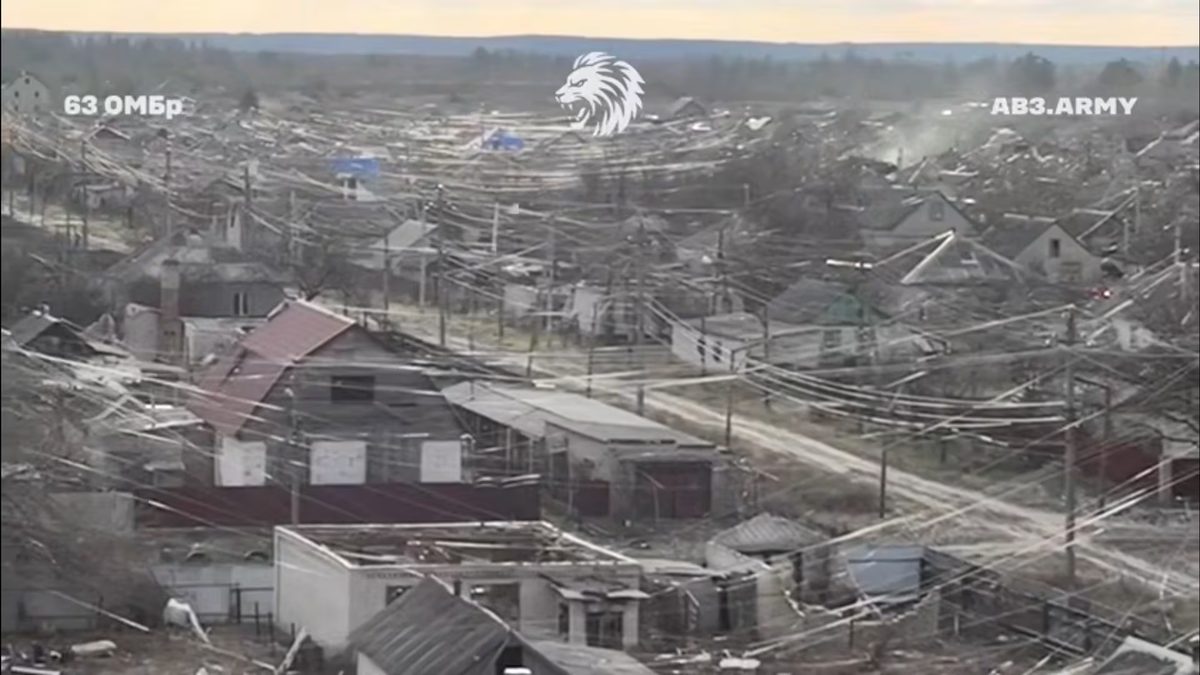
Fiber-optic drones deserve particular attention. By connecting the drone to its operator via a hair-thin fiber-optic cable (similar in thickness to fishing line), both sides created communication channels completely immune to electromagnetic jamming. The trade-off is range—typically 10–20 kilometers—but within that range, reliability is absolute. Russia pioneered mass deployment during the Kursk Oblast campaign; by 2025, both sides used fiber-optic FPV drones extensively along the entire 1,200-kilometer front line.
The fiber-optic solution illustrates a broader pattern: every electronic countermeasure generates a physical counter-countermeasure. Jam the radio? Use a wire. Jam the GPS? Use visual navigation. Jam the data link? Use onboard AI. The attacker always has an alternative because the fundamental physics—a small flying object carrying an explosive to a target—does not depend on any single electromagnetic technology. The defender, by contrast, must defeat every variant simultaneously. This asymmetry structurally favors the attacker.
KEY INSIGHT: The EW innovation cycle in Ukraine has compressed from months (2022) to days (2025). Each Russian jamming advance is countered by Ukrainian AI or physical workarounds within weeks. Fiber-optic drones eliminated RF vulnerability entirely within the 10–20 km combat zone. AI visual navigation eliminated GPS dependency. The attacker always finds an alternative; the defender must defeat all alternatives simultaneously.
Fiber-Optic Drones Weave Spiderweb Barriers in Ukraine War: